


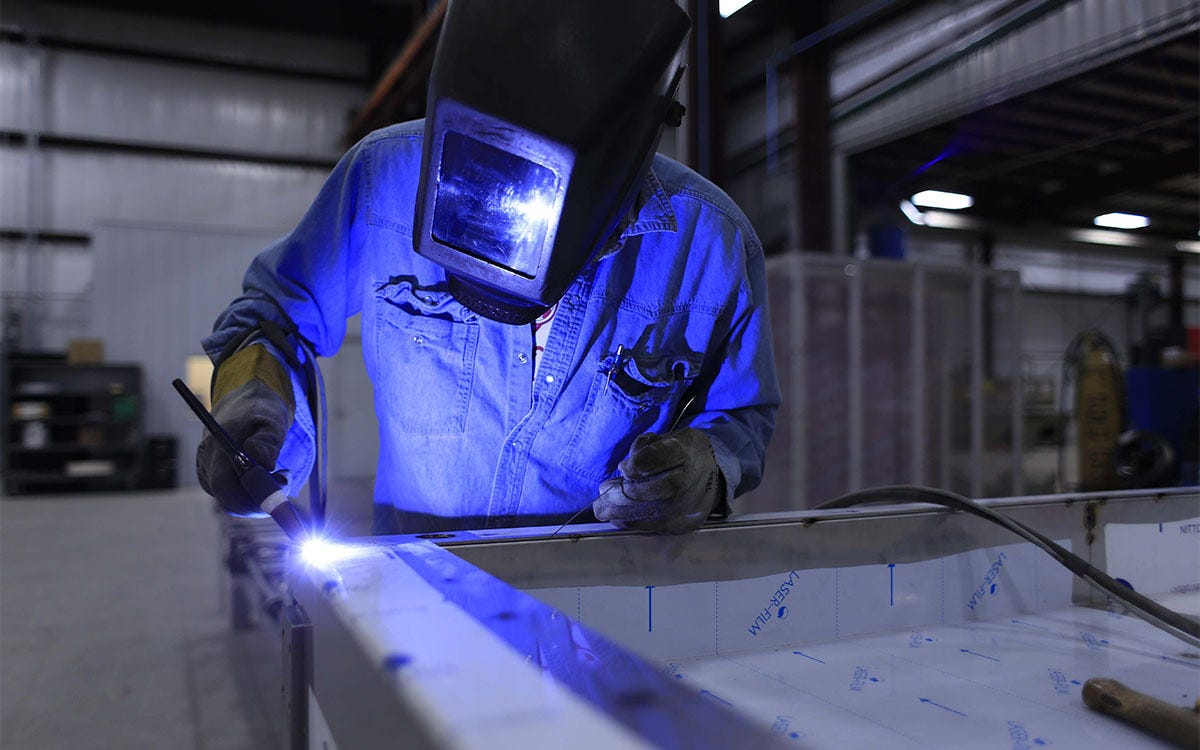
The students in a graduate-level course I teach on the social impacts of artificial intelligence include a game designer, a warehouse manager, and an HR specialist. Many of them express concern that their current jobs could disappear as AI is implemented in their industry. Yet when I visited a trade school in Newark, Ohio, there was little such concern.
High-school graduates being trained for jobs in fields such as machining or plumbing were confident that their skills were in high demand — and would remain that way. These young people, not the nerds and “symbolic analysts,” may prove the winners of the next great transition, one that is more tied to the production of tangible goods than the manufacturing of digits and images.
A world dominated by digital technology once seemed to be the inexorable future, yet we are exiting the Information Age.
This transition has many implications: political, economic and social. It benefits investors, regions, and individuals tied to producing the tangible world, from consumer goods to missiles, spacecraft to oil and gas. The big stock winners so far in 2026 have been firms in energy, materials, consumer staples, and industry.
More important still, the transition is creating a cultural revolution driving young people away from traditional four-year colleges towards practical skills. The next generation of American workers, in other words, is skipping Joe Biden’s famous advice to “learn to code.” Goodbye to “my son the computer geek,” and hello to “my son, the plumber.”
To be sure, the information economy has had a remarkable run and has elevated seven of the world’s eight richest people. The companies founded by these multi-billionaires are worth more than most countries, at least on paper; put together, their valuation exceeds China’s gross domestic product. Apple alone is worth more than Canada’s GDP and has a valuation at about the GDP of Italy.
This agglomeration of wealth and power and the prospect of a populace thriving as “symbolic analysts,” as the political economist (and Clinton labor secretary) Robert Reich described it in the 1990s, persuaded political elites of both parties not to stress about the demise of the country’s industrial base. Christina D. Romer, the former head of the Council of Economic Advisers in the Obama administration, dismissed “manufacturing policy” as nostalgia driven by “sentiment,” declaring: “American consumers value health care and haircuts as much as washing machines and hair dryers.”
The great transition should put an end to such thinking. As long as countries eschew energy and industrial development, they will inevitably fall behind those that either control energy or make real things necessary in the real world, including for military purposes. This is why China, now using its industrial wealth to pursue technological supremacy, matters most after the United States; and why the oil-rich Persian Gulf region still matters a great deal. In contrast, Western Europe, deindustrializing and seemingly committed to energy scarcity, becomes ever more irrelevant.
The pandemic and now the Hormuz crisis demonstrate why countries need strong energy and industrial sectors. Covid exposed America to the bleak reality that it could not provide basic medical equipment like masks or the basic components of pharmaceuticals. The inability to shift energy primacy from the fundamentally unstable Persian Gulf and Red Sea, places America and (even more so) the rest of the industrialized world at the mercy of unstable regimes.
The great transition offers a way out of the West’s decline. The allure of a software-led economy has diminished, in large part because incremental increases in algorithmic technology have done very little to expand wealth beyond the elite classes. This is epitomized by the bastion of the digital economy, California, where great wealth has been created for a relative few, while middle- and working-class prospects have deteriorated and poverty has reached alarming levels.
Read the rest of this piece at UnHerd.
Joel Kotkin is the author of The Coming of Neo-Feudalism: A Warning to the Global Middle Class. He is the Roger Hobbs Presidential Fellow in Urban Futures at Chapman University and and directs the Center for Demographics and Policy there. He is Senior Research Fellow at the Civitas Institute at the University of Texas in Austin. Learn more at joelkotkin.com, follow him on Substack and Twitter @joelkotkin.
Photo credit: Jon Kline, via Pixabay.
yes but a generation is a long time maybe two generations
better off than the nerds
What gives you that idea?
You don’t believe that an AI robot won’t be able (in a matter of a generation) to climb a ladder and weld a structural connection?
https://g.co/gemini/share/2d2356a8e3d9